What is 'Trust the Play'?
Trust the Play.
It sounds simple. And, well, it kind of is?
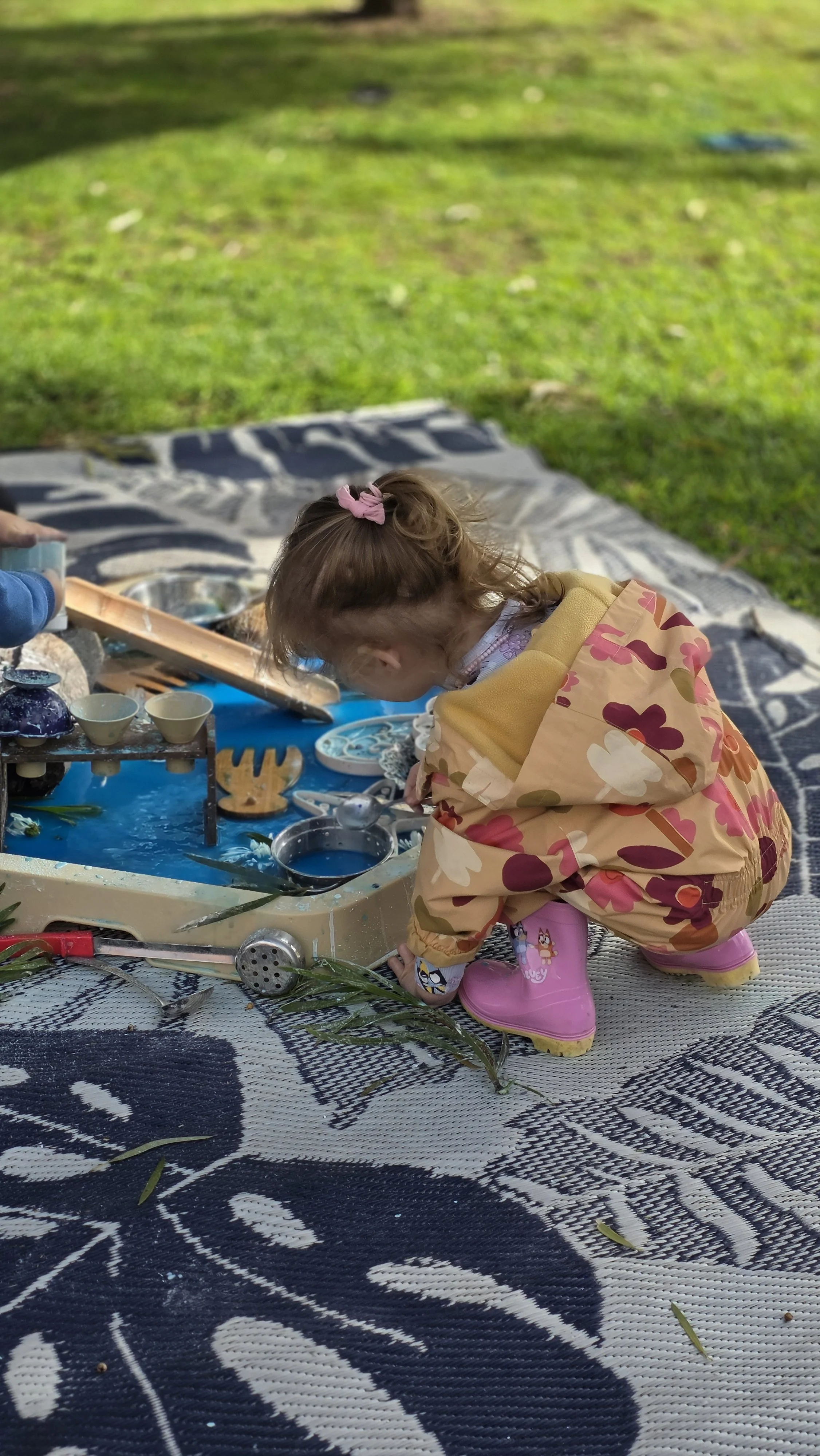
Trust the Play is the philosophy sitting underneath everything I do at Mud Buddies. It means trusting that children don't need us to make their play meaningful. They don't need us to turn every moment into a lesson, show them the ~right~ way to use something, ask what colour it is or what they're making, or keep the beautiful sensory tray looking beautiful.
Sometimes they just need us to give them interesting things, time, a safe-enough space and permission to see what happens. And then (and this is often the hardest bit!) get out of the dang way.
The play is already doing the work
When a toddler spends twenty minutes transferring water from one completely unnecessary container to another, we don't need to turn it into a pouring activity. Coz guess what? They're already learning.
When they climb, balance, haul, tip, mix, squash, destroy, rebuild, repeat, negotiate and experiment, their bodies and brains are already doing an extraordinary amount of work. They're exploring cause and effect, problem solving, sensory information, risk, frustration, persistence and their own capabilities!
We don't need to sneak learning into play. It's already there.
And sometimes knowing all the developmental stuff can actually make this harder to remember. I can tell you about fine motor skills and proprioception and vestibular input and motor planning and schemas and executive function. Those things are fascinating and important, but children don't need to know they're working on bilateral coordination while hauling a bucket of mud across the garden.
They're just playing.
And that's enough.
Where Trust the Play comes from
I didn't invent child-led play, and I think it's important to say that.
Trust the Play is my way of bringing together ideas from Play work, nature play, risky play, sensory development, process art and child-led early childhood practice, alongside years spent watching tiny humans actually play.
Play work in particular gives language to so much of what I've come to believe. Playworkers talk about protecting children's freely chosen play, noticing children's play cues, responding rather than directing, understanding the play cycle, and being conscious of the ways adults can unintentionally take over children's play.
And once you start noticing that, you see it everywhere.
A child is completely absorbed in pouring mud between two cups. “What colour is your cup?” They're carefully balancing along something. “Be careful!” They're mixing every colour of paint into one glorious shade of brown. “No, no! Don't mix them!” They're building something. “Is that a house?”
We mean well. We really bloody do. We're trying to be engaged parents. We're trying to teach them, keep them safe and show them (and sometimes the people around us), that we're present.
But sometimes our involvement changes the play from theirs into ours.
Trust the Play asks us to notice that.
Connection doesn't have to look like constant interaction
This is something I really want parents to hear: trusting the play doesn't mean ignoring your child.
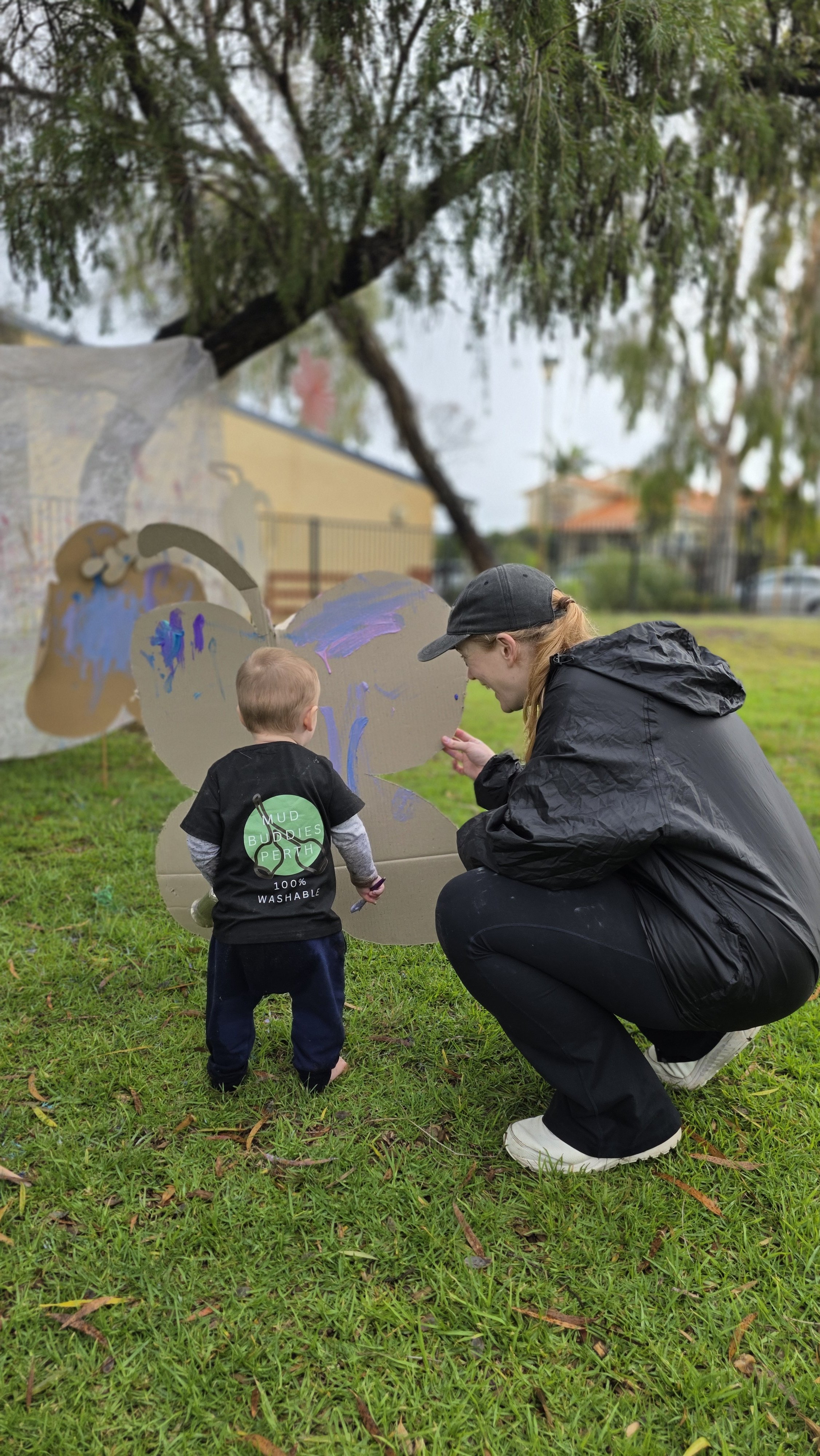
Sit beside them. Watch. Smile when they look up at you. Accept the questionable mud soup they hand you. Respond when they invite you in. Help when they genuinely need you. Laugh with them. Get muddy with them.
You just don't have to constantly perform engagement.
Sometimes being a beautifully engaged parent looks like sitting nearby drinking your coffee while your toddler spends fifteen minutes putting rocks into a bucket. You're there. You're available. They know it.
That's connection too.
Is it dangerous, or is it just inconvenient?
This question has become one of the biggest parts of Trust the Play, because I've realised that adults (myself included!) sometimes say no when what we really mean is: I don't particularly want you to do that.
Climbing up the slide. Getting completely soaked. Putting their whole body into something that was definitely intended for their hands. Taking the long way. Moving seventeen objects from one side of the garden to another. Getting muddy. Mixing everything together. Doing something in a way we hadn't even imagined.
So before I intervene, I try to ask: Is it actually dangerous? Is someone else being harmed or having their play seriously disrupted? Or is this simply messy, slow, weird or inconvenient for me?
Trusting children doesn't mean abandoning boundaries or ignoring genuine danger. It means being curious about whether the boundary is there for their safety or our convenience.
Those are not always the same thing.
The environment matters. The outcome doesn't.
I'm actually incredibly intentional about the environments I create. There are herbs and flowers, mud and water, strange tools, vessels, textures, loose parts, things to haul, things to squash, things to pour and things I'm reasonably confident someone will climb inside despite that absolutely not being my original intention.
That's intentional.
What happens next isn't.
I might create the invitation, but the child decides what the invitation becomes.
A potion station doesn't require anyone to make a potion. Paint doesn't require a picture. Playdough doesn't require a creation. A beautifully arranged sensory tray is allowed to be completely annihilated. Actually, sometimes annihilating it is the play.
This is where Trust the Play also draws heavily from process art: the experience matters more than producing something adults recognise as a finished product.
The setup is not the activity. The child's play is the activity.
Our job isn't to make childhood productive
I think somewhere along the way we've become incredibly anxious about children's time. We want to know what they're learning, what skill they're developing and what the activity is for.
But sometimes the simplest truth gets lost underneath all of that: children are allowed to play because playing is worth doing.
Not because it prepares them for school. Not because we can attach an outcome to it. Not because we can photograph the finished product. Not because an adult has decided what they should learn from it.
Because childhood isn't preparation for something more important.
Maybe Trust the Play is about trusting ourselves too
Trust the Play asks something of adults as well. It asks us to unlearn a little bit. To notice the urge to correct. To resist immediately rescuing. To sit with a little mess, uncertainty and inconvenience. To stop worrying about whether we're doing enough and start noticing what our children are already doing.
Because our job isn't to make their play valuable. It already is.
Our job is to give them time, space, interesting things, nature, challenge, permission, a safe place to return to, and adults who believe they're capable.
And then?
Trust. The. Play.